Having purchased a new radiator for the hall, deciding that the old type 11 radiator was not in-keeping and unsightly, I decided to replace it with a new 2 column radiator of the same height and width.
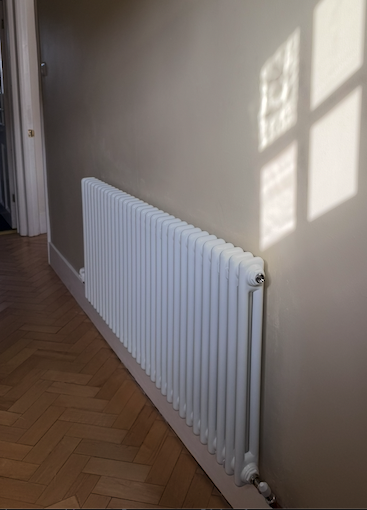
What I didn't account for was the weight difference and the increase in water volume,
| Type 11 | 2 Column | |
|---|---|---|
| Water Volume | 4.2 Ltr | 21.84 Ltr |
| Dry Weight | 22.2 kg | 27.72 kg |
My plan had been to use hollow wall anchors, they are rated for 18kg per 1m2 of plasterboard, which would be near the limit.
When I placed the radiator on the wall using these anchors, the wall flexed around the anchors, and this was without water. Having noticed this I did not feel comfortable proceeding with this approach.
The solutions I found to this problem where not "ideal":
I didn't like the idea or "look" of having a sheet of ply on the wall because of the obvious visual intrusion. The wall appears to be "Honeycomb" plasterboard, which is two sheets of plasterboard with a card honeycomb centre. That means there are no studs in the wall, and it would be difficult to cut the wall open and insert noggins because of this honeycomb.
Given all of this I decided to change the layout of the brackets, the new radiator had 6 brackets, 3 for the top and 3 for the bottom. I understand that the bottom brackets don't support the weight and are used to keep the radiator aligned to the wall, so I used 4 brackets at the top and 2 at the bottom.
This in theory would work, as 18kg x4 is less than the combined weight, but I didn't like my chances, fearing I would return home to a crushed cat one day.
I decided to use some out of the box thinking, given the wall has a honeycomb centre, this makes the wall somewhat stable and impact resistant, and able to handle compression. I decided to use 100mm m6 bolts and some homemade oak washers.
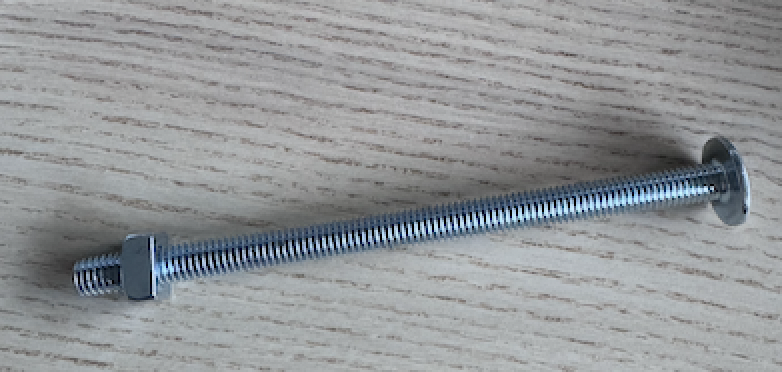
The 4 m6 bolts go all the way through the wall into the adjacent room; the oak washer, penny washer and nut are conveniently hidden behind the radiator in that room.
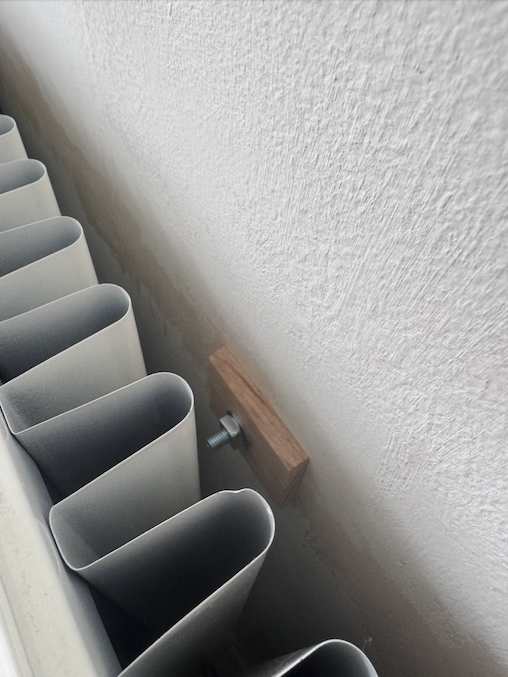
Overall I am happy with the job, the radiator does not move, the wall hasn't changed or bowed. I decided to write this up because I could not find this approach mentioned on my searches, but I did find many pictures of radiators having been pulled out of plasterboard walls.
11th of February 2026.